
Posted on September 22, 2025 by
A mobility scooter restores a lot of independence — but only if you can actually get it where you're going. For many users, that means loading it into a car for grocery runs, medical appointments, family visits, or travel.
How you do that depends on two things: the weight and design of your scooter, and what vehicle you're working with. This guide covers every practical option, from lightweight disassembly to vehicle lifts, and explains which approach works best for which situation.
Step 1: Know Your Scooter's Weight and Design
Everything else follows from this. Scooters generally fall into three categories for transport purposes:
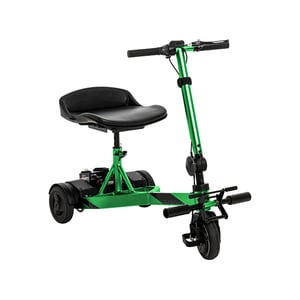 Lightweight / travel scooters (under 50 lbs. per piece) Designed specifically for transport. They disassemble into 3–5 pieces — typically the tiller, seat, battery, and base — with the heaviest individual piece weighing 35–50 lbs. Most can be lifted into a standard car trunk by one person, though it helps to have a second person for heavier pieces.
Mid-size scooters (50–100 lbs. assembled) These may disassemble, but individual pieces can still be heavy. One person can often manage with practice, but a ramp or a second person makes it significantly easier and safer.
Full-size / heavy-duty scooters (100+ lbs.) Not practical to lift manually. These require a vehicle lift or ramp system. Attempting to lift a heavy scooter without the right equipment is a common cause of back injuries for both users and caregivers.
If you're buying a scooter specifically because you want to travel with it regularly, transportability should be a primary factor in your decision — not an afterthought. APA Medical can help you choose a model that fits both your mobility needs and your vehicle. Call 612-722-9000 or contact us online.
Option 1: Manual Disassembly and Lifting
For lightweight travel scooters, this is the simplest and most common approach. The process varies slightly by model, but generally follows the same steps:
- Park on a flat, stable surface with the trunk accessible
- Remove the seat (usually lifts straight off or releases with a lever)
- Remove the battery (slides out or disconnects — check your model's manual)
- Fold or remove the tiller
- Lift the base into the trunk — this is typically the heaviest piece
- Place the remaining components around the base
The key is knowing which piece is heaviest and positioning yourself correctly before lifting it. Bending at the knees, keeping the load close to your body, and not twisting during the lift reduces the strain significantly.
APA models well suited to manual transport:
Pride Go-Go Elite Traveler 3 Wheel Lightweight travel scooter that disassembles for transport. Designed for portability and everyday use — a practical choice for anyone who needs to load and unload frequently.
Buzzaround EX 3 Wheel Disassembles in four steps. Compact enough for most vehicle trunks. A solid mid-range option for frequent travelers.
Option 2: Portable Loading Ramps
A portable ramp lets you drive a scooter up into a vehicle rather than lifting it. This is practical for SUVs, minivans, and vehicles with a low enough cargo floor to make the ramp angle manageable.
What to look for in a loading ramp:
- Width: should be wider than your scooter's wheelbase, typically at least 12 inches per side
- Length: longer ramps create a shallower angle, which is easier and safer — a ramp that's too short creates a steep incline that's difficult to manage
- Weight capacity: must exceed the weight of the scooter, ideally with significant margin
- Portability: the ramp itself needs to be stored in the vehicle, so weight and folding dimensions matter
Ramps work well when there's room to position them alongside the vehicle and someone available to guide the scooter up. In tight parking spaces or without a second person, they can be harder to manage.
Option 3: Exterior Vehicle Lifts (Hitch-Mounted)
A hitch-mounted exterior lift attaches to the receiver hitch on the back of a vehicle. The platform lowers to ground level, the scooter drives or rolls onto it, and the lift raises and locks the scooter for transport outside the vehicle.
Advantages:
- No need to disassemble the scooter — it transports fully assembled
- Keeps the scooter outside the vehicle, preserving full cargo space inside
- Works with most SUVs, trucks, and minivans that have a 1.25" or 2" receiver hitch
- Platform folds when not in use
Considerations:
- Adds to the vehicle's overall length — relevant for parking and garage clearance
- The scooter is exposed to weather during transport; a cover is recommended
- Requires a vehicle with an appropriate hitch rating for the scooter's weight
This is one of the most practical long-term solutions for people with mid-size to heavier scooters who need to transport regularly.
Option 4: Interior Vehicle Lifts
Interior lifts are installed inside the vehicle's cargo area. The platform extends out through the open tailgate, lowers to ground level, and retracts back into the cargo area with the scooter secured on it.
Advantages:
- Scooter is protected from weather during transport
- Works well for vans and larger SUVs with sufficient cargo height
- Fully automated versions require minimal physical effort
Considerations:
- Requires a vehicle with adequate cargo area height and depth
- Reduces available cargo space
- Higher cost than exterior lifts and typically requires professional installation
Interior lifts are the most convenient option for frequent travelers who have the right vehicle and budget, but they're overkill for occasional use.
Which Vehicle Types Work Best
Minivans: The most versatile option for scooter transport. Folding rear seats create a flat cargo floor, and the low floor height makes ramp loading practical. Interior lifts fit well. Exterior hitch lifts work too.
SUVs (mid-size and full-size): Good option for manual disassembly of lightweight scooters or hitch-mounted exterior lifts. Cargo floor height varies — check before assuming a ramp approach will work.
Sedans and hatchbacks: Manual disassembly only, and only for the lightest travel scooters. Not suitable for ramps or lifts in most cases.
Trucks: Exterior hitch lifts work well. Bed loading without a lift is generally not practical due to tailgate height.
Model-Specific Disassembly: APA's Current Lineup
Pride Victory 10 (3-wheel and 4-wheel) Disassembles with one-hand feather-touch release. Seat, battery, and front section separate for loading. 400 lb. weight capacity, up to 15.5 mile range. One person can manage with practice; a ramp or second person makes it easier.
Pride ZT10 Heavier than the Victory 10 due to its dual-motor design and larger frame. 400 lb. capacity, up to 24 mile range at 200 lbs. Best transported with an exterior hitch lift or ramp rather than manual lifting.
Pride Wrangler / Baja Raptor Heavy-duty outdoor models. Not practical for manual lifting. Exterior vehicle lift is the right solution for regular transport of these models.
Pride GoGo Folding Folds in three steps. Good middle ground between the iRide's simplicity and the larger models' range and capacity.
If you're unsure how your specific model breaks down, APA Medical can walk you through it. Call 612-722-9000 or come into our Minneapolis showroom and we'll demonstrate the process.
Securing the Scooter During Transport
Whether you're using manual loading or a lift, the scooter needs to be secured before driving. An unsecured scooter in a moving vehicle can shift, tip, or damage both itself and the vehicle interior.
- Use tie-down straps through the scooter's frame — not through plastic body panels
- For lift-mounted transport, use the platform's built-in locking mechanism and add straps as backup
- Check that the scooter is stable and the battery is disconnected or secured before driving
Frequently Asked Questions
What is the easiest mobility scooter to transport? The LiteRider Envy is one of the easiest — heaviest piece is 35 lbs., disassembles in seconds, fits in virtually any car trunk. The Pride iRide is similarly portable. Both are designed with frequent transport in mind.
Do I need a special vehicle for a mobility scooter? Not for lightweight travel scooters — they fit in most standard trunks. For heavier models, a vehicle with a receiver hitch (for an exterior lift) or sufficient cargo area (for an interior lift or ramp) makes transport significantly easier.
What is the lightest scooter for travel? The LiteRider Envy at 35 lbs. for the heaviest single piece is among the lightest available in APA's lineup. The Pride iRide is also designed for travel and is similarly portable.
Can mobility scooters go on airplanes? Most commercial airlines accept battery-powered mobility scooters as checked mobility aids at no extra charge under the Air Carrier Access Act. Requirements vary by airline and battery type — sealed lead acid and specific lithium batteries are generally accepted, but you should confirm with your carrier before booking. The scooter must be properly packaged or prepared per airline guidelines.
Can you take a mobility scooter on public transit? Yes. Under ADA regulations, all fixed-route public transit must accommodate mobility devices including scooters when space allows. Let the driver or conductor know in advance when possible, apply the brakes once boarded, and use any available securement systems.
Get Help Choosing the Right Scooter for Your Lifestyle
If you're deciding between scooter models and travel frequency is a factor, APA Medical can help you compare options in person. Our Minneapolis showroom lets you see and test scooters before you buy, and our team can advise on which models work best with your vehicle.
Call 612-722-9000 or contact us online to get started.
For a full overview of APA's scooter lineup, see our mobility scooter buyer's guide. To browse scooter models, visit our mobility scooters product page.